Collective Intellect Clinical Case Discussion Platform (CICCDP)
APCO CICCDP Case Updates
APCO CICCDP Session 15 on 14 July 2026 - Case Updates
Case 1:
- Presented by Dr Vanessa Rouach, an Endocrinologist at the Tel Aviv-Sourasky Medical Center in Israel.
- The case involved a 70-year-old woman with osteoporosis who had received denosumab for 15 years and subsequently sustained a subtrochanteric femoral fracture following a CT guided biopsy of a suspicious femoral lesion. Although the patient had a history of breast cancer, the panel concluded that the fracture was most consistent with a biopsy related insufficiency fracture rather than an atypical femoral or pathological fracture. The experts recommended review of the biopsy by a musculoskeletal pathologist, assessment of bone turnover markers, and consideration of transitioning from denosumab to zoledronic acid.
Case 2:
- Presented by Dr Liang Wei Wong, an Endocrinologist at Putrajaya Hospital in Malaysia.
- This case involved a 30-year-old woman who was initially diagnosed with primary hyperparathyroidism and underwent unsuccessful parathyroid surgery before genetic testing identified a calcium sensing receptor gene mutation consistent with Familial Hypocalciuric Hypercalcemia (FHH). The panel agreed that the patient had isolated FHH rather than concurrent primary hyperparathyroidism and recommended discontinuing cinacalcet, and providing genetic counselling for future pregnancy planning, including neonatal calcium monitoring.
APCO CICCDP Session 14 on 12 May 2026 - Case Updates
Case 1:
- Presented by Dr Shiga Rappai Chirayath, a Paediatric Endocrinologist at Sidra Medicine in Doha, Qatar.
- The case involved a 11 year old boy with developmental delay, autism, and endocrine abnormalities including hypothyroidism and growth hormone resistance. Clinical imaging revealed diffuse osteosclerosis of the skull, vertebrae, and limbs. Although initial testing showed a chromosome 6 duplication, the panel noted this did not explain the skeletal phenotype and suggested a genetic high bone mineral density disorder, likely autosomal recessive. Experts agreed to prioritize whole exome sequencing and bone turnover markers over biopsies to determine if the patient's skeletal dysplasia and endocrinopathies share a single genetic origin.
Case 2:
- Presented by Dr Semini Gunawardane, a Senior Registrar in Endocrinology at the National Hospital of Sri Lanka.
- This case involved a 48 year old male with progressive weakness, severe hypophosphatemia, and osteomalacia. Despite biochemical improvement on phosphate and vitamin D supplements, persistently elevated FGF23 levels and an FDG-PET positive femoral lesion shifted the diagnosis toward tumour-induced osteomalacia. The panel discussed the limitations of FDG-PET for localizing such tumours and recommended a Gallium-68 DOTATATE scan for its superior sensitivity to somatostatin receptors. The experts advised prioritizing precise localization before surgery or biopsy while suggesting burosumab therapy as a potential management strategy if the lesion remains inaccessible.
APCO CICCDP Session 13 on 10 March 2026 - Case Updates
Case 1:
- Presented by Dr Vikas N, Endocrinology Resident at Narayana Healthcity in Bangalore, India, under the supervision of Dr Subramanian Kannan, Senior Consultant and Director at the same institute.
- The case involved a 69-year-old post-menopausal woman with osteoporosis who developed bilateral atypical femur fractures after long-term osteoporosis therapy. Initial evaluation centred around a diagnosis of possible normocalcemic primary hyperparathyroidism, and she was treated with cinacalcet and antiresorptive therapy, with some biochemical improvement. However, the panel discussion focused on alternative explanations for her hyperparathyroidism including the use of thiazide diuretics. Importantly, persistently low normal alkaline phosphatase levels and characteristic femur X-ray findings raised suspicion for hypophosphatasia. The panel recommended prioritising further biochemical evaluation and possible genetic testing, as well as family screening, before pursuing parathyroid imaging, while also discussing fracture management strategies and future treatment considerations.
Case 2:
- Presented by Dr Noor Ashikin Ismail, Endocrinologist at the Endocrine Institute in Putrajaya Hospital, Malaysia.
- This case involved a 43-year-old woman with low bone density identified during routine screening, with a lumbar spine T-score of -3.7. The panel discussed that her low bone density was most likely due to failure to achieve optimal peak bone mass, possibly related to a history of being underweight and potential eating disorders, rather than typical age-related osteoporosis. Given her low fracture risk and stable bone density, the group agreed that anabolic or aggressive anti-osteoporosis therapy was not required. Instead, they supported continuing Tibolone for bone preservation, while acknowledging potential cardiovascular considerations with its long-term use in older patients. The panel also emphasized lifestyle measures including adequate protein intake, weight-bearing and resistance exercise, and fall prevention, with plans to reassess bone health and consider osteoporosis-specific therapy later, around the age of 55-60 if needed.
APCO CICCDP Session 11 on 18 November 2025 - Case Updates
Case 1:
- Presented by Dr Ipsita Mishra, Associate Professor & HOD at IMS and SUM Hospital in Odisha, India.
- The case involved a 39 year old woman recurrent primary hyperparathyroidism due to a pathogenic CDC73 mutation (HPT-JT syndrome). Despite prior surgery, she had elevated PTH with normal calcium, raising concern for recurrence and possible carcinoma. The panel recommended close surveillance with 6-monthly calcium and PTH checks, noting surgery was not immediately needed without tumour or end-organ involvement. Given the aggressive nature of CDC73 mutations, they suggested a low threshold for further imaging and potential bilateral exploration if markers rise, and highlighted the value of IHC or genetic review of prior tissue. They also emphasized maintaining vitamin D, considering family screening, and recognising the high recurrence risk. Cinacalcet was discussed but discouraged due to normocalcemia. Overall, the panel supported vigilant follow-up with readiness for surgery if progression occurs.
Case 2:
- Presented by Dr Myint Myint Thein, Senior Consultant Physician at Ar Yu Hospital in Yangon, Myanmar.
- This case involved a 78 year old woman with severe osteoporosis and an atypical femoral fracture after sequential anti-resorptive therapy (one year of denosumab, three years of alendronate). The patient had been on teriparatide for one year but wished to stop, prompting discussion on optimal dosing. The panel agreed that extending teriparatide for 1-2 more years would be most beneficial given her T-score of 2.4 and recent AFF. If continuation was not possible, a weekly 60 µg regimen was considered suitable for lower body weight patients. Anti-resorptives were avoided at this stage due to incomplete fracture healing. The group emphasized monitoring fracture recovery with contralateral femur assessment, radiographs, DEXA, and single-energy femur scanning. Overall, the consensus focused on optimizing anabolic therapy, delaying anti-resorptives, and careful imaging based follow-up in this high risk elderly patient.
APCO CICCDP Session 10 on 16 September 2025 - Case Updates
Case 1:
- Presented by Dr Prasoona L. Deepak, senior resident at the Amrita School of Medicine in Cochin, Kerala, India.
- The case involved a 66-year-old woman with a history of vertebral compression fractures dating back to 2016. Despite treatment with bisphosphonates and zoledronic acid, she continued to experience fragility fractures. Genetic testing revealed a VUS in the IFITM5 gene (osteogenesis imperfecta type 5) and LDLR mutation consistent with familial hypercholesterolemia. The panel explored management challenges including low alkaline phosphatase levels which suggested a diagnosis of hypophosphatasia, high cardiovascular risk, and the potential roles of teriparatide, denosumab, and romosozumab in her care.
Case 2:
- Presented by Dr Asma Aljaberi, consultant endocrinologist at Tawam Hospital/ STMC in Abu Dhabi, UAE & Adjunct Asst Prof at United Arab Emirates University.
- This case involved a 41-year-old man with persistent low vitamin D levels despite high-dose supplementation, low bone mineral density, chronic joint pain, and low BMI. Investigations had excluded osteomalacia, celiac disease, hypophosphatasia, and other metabolic bone diseases. The panel suggested his bone density issues may be constitutional but recommended further evaluation, including sacroiliac MRI, anterior chest wall imaging, HLA-B27 testing, and urine homogenic acid to rule out ochronosis. Differential diagnoses such as seronegative spondyloarthropathy and SAPHO syndrome as well as the possibility of a partial CYP2R1 deficiency accounting for his clinical presentation were actively debated.
APCO CICCDP Session 9 on 8 July 2025 - Case Updates
Case 1:
- Presented by Dr Shiga Rappai Chirayath, a Pediatric Endocrinologist at Sidra Medicine in Doha, Qatar.
- The case involved a 3-year-old girl with Winchester syndrome. The patient had progressive hand pain, joint deformities, and progressive osteolysis. Initial treatment with analgesics, and steroids provided limited relief, leading to a switch to adalimumab, methotrexate and zoledronic acid. The expert panel emphasized the role of VFA, and adequate vitamin D levels, and recommended genetic testing (MMP2/MMP14) and a full skeletal survey. Differential diagnoses such as progressive pseudo-rheumatoid arthritis, MONA and Hejdu Cheney Syndrome were discussed, along with the challenges in diagnosing osteoporosis in paediatric populations, the need for a multidisciplinary approach and potential use of steroid-sparing agents like MMF in this patient.
Case 2:
- Presented by Dr Dinithi Ruwanga, a Senior Registrar in Endocrinology at Sri Jayewardenepura General Hospital in Sri Lanka.
- This case involved a 60-year-old postmenopausal woman with recurrent fractures since 2018, despite ongoing osteoporosis treatment. X-rays and DXA scans raised concerns about atypical fractures with normal BMD, prompting the expert panel to suspect hypophosphatasia. They emphasized the need for further investigations, including genetic testing and family screening, although financial constraints posed a major barrier. The panel also discussed treatment options such as teriparatide, acknowledged its high cost, and offered support with genetic analysis to aid diagnosis and management.
APCO CICCDP Session 8 on 14 May 2025 - Case Updates
Case 1:
- Presented by Dr Zar Chi Pyone, a Junior Endocrinologist at Yangon General Hospital, University of Medicine 1, Myanmar.
- The case involved a 42-year-old female with hypophosphatemia diagnosed with Tumour Induced Osteomalacia after a long and tortuous clinical course. Following excision of the patient’s nasal sinus tumour that was the source of increased FGF23 production and the cause of her hypophosphatemia, she had dramatic improvements in her symptoms with restoration of height and bone mineral density. Dr Zar Chi Pyone sought the panel’s advice on discrepancies in FGF23 levels between plasma and serum and whether this represented a case of true tumour-induced osteomalacia. The expert panel extensively discussed the case, with each panelist offering valuable insights and recommendations for the patient’s ongoing management.
Case 2:
- Presented by Dr Nikhel Sachdev, a Senior Resident in the Department of Endocrinology at Singapore General Hospital.
- This case involved a 22-year-old female with an aggressive form of fibrous dysplasia. Dr Sachdev detailed the patient’s history, multiple surgeries, and the associated diagnostic and management challenges. Prof Javaid and the other panelists offered their expert opinions particularly on potential next steps in management of this incredibly complex and challenging case.
APCO CICCDP Session 7 on 11 March 2025 - Case Updates
Case 1:
- Presented by Dr Narayanan Rajeshwari, a Fellowship-trained Clinical Geneticist and Chief Consultant Paediatrician and Developmental Neurologist at Dr. Kamakshi Memorial Hospital in Chennai, India.
- The case involved a 10-year-old female diagnosed with Type 1 non-neuronopathic Gaucher Disease, left femur osteomyelitis, and Salmonella septicemia. Despite one year of Enzyme Replacement Therapy (ERT), the patient’s bone disease showed no improvement. Dr. Rajeshwari sought the panelists’ advice on future treatment options. The case was extensively discussed by our expert panel, with each panelist providing valuable insights and recommendations for the patient’s management.
Case 2:
- Presented by Dr Nupoor Vaghasia, a Endocrinology Resident at Max Super Speciality Hospital in Saket, India.
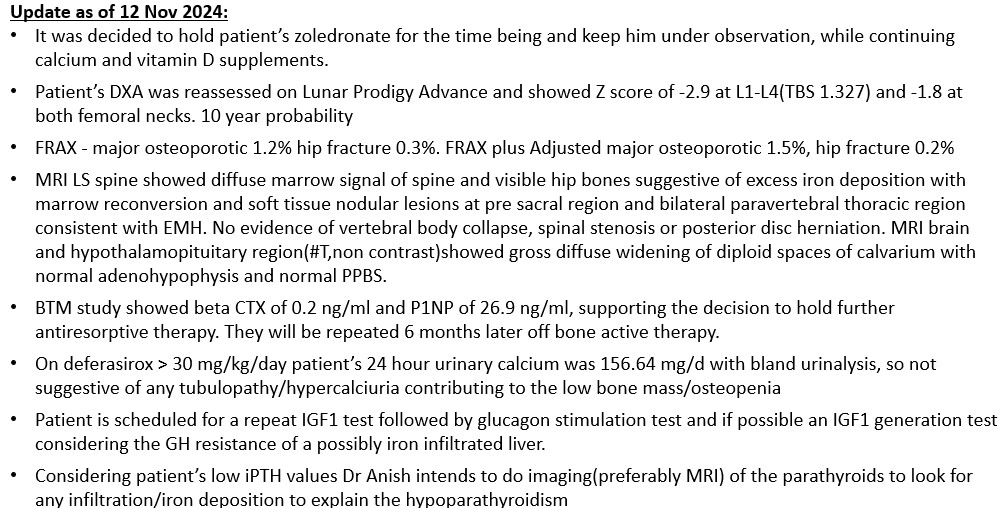
- This case involved a 49-year-old male with thalassemia major and severe generalized bone pain. The panelists explored the potential causes of the patient’s hypophosphatemia and its impact on treatment. Dr. Vaghasia sought their insights on whether hypophosphatemia could be contributing to the patient’s lack of response to osteoporosis treatment and requested recommendations for optimal osteoporosis management in such cases.
APCO CICCDP Session 6 on 14 January 2025 - Case Updates
Case 1:
- Presented by Dr Tran Ha Uyên, a Resident Physician in the Department of Internal Medicine at the University of Medicine Pham Ngoc Thach, Vietnam.
- The case involved a 51-year-old male who had osteomalacia and Fanconis Syndrome. Dr Uyên sought guidance on managing the patient and requested advice on elucidating the cause of the patient’s protracted hypophosphatemia that was associated with renal phosphate wasting. This case was thoroughly discussed by our expert panel, with each panelist offering unique perspectives on the findings and recommendations for the patient’s management. The discussion also included suggestions for additional tests to obtain a more conclusive understanding of the patient’s condition.
Case 2:
- Presented by Dr Dinithi Ruwanga, a Senior Registrar in Endocrinology at the Sri Jayewardenapura General Hospital, Sri Lanka.
- This case involved a 37-year-old female with lactation-associated osteoporosis with worsening BMD on anti-resorptive treatment. Prof Manju Chandran highlighted an important point in interpretation of DXA scan namely the regions of interest that are included in serial scans. The panelists addressed the issue of the patient’s elevated parathyroid hormone (PTH) levels, fluctuating calcium levels, and low urinary calcium excretion as well as explored the potential options for treatment of pregnancy and lactation associated osteoporosis.
APCO CICCDP Session 5 on 12 November 2024 - Case Updates
Case 1:
- Presented by Dr Marjorie Faye Nierra, a 2nd year Rheumatology Fellow at the University of Santo Tomas Hospital in Manila, Philippines.
- The case involved a 63-year-old female with Systemic Lupus Erythematosus (SLE) and Glucocorticoid-Induced Osteoporosis (GIOP). The expert panel engaged in a dynamic discussion addressing Dr Marjorie’s concern about the multiple fractures the patient had been experiencing and provided strategies to mitigate the risk of further fractures.
Case 2:
- Presented by Dr Rasha Amin, a Pediatric Endocrinology Fellow at the Division of Pediatric Endocrinology and Diabetes at Sidra Medicine in Doha, Qatar.
- The case involved a 7-year-old boy with hypocalcemia secondary to Autosomal Recessive Vitamin D Resistant Rickets. Faced with the patient's poor response to oral medication and infusions, Dr Rasha sought guidance on how to manage the patient. Prof Manju Chandran provided the participants with insights into Vitamin D Resistant Rickets, while experienced Pediatric Endocrinologist Dr Ganesh Jevalikar provided his expert opinion on tailoring treatment for such complex cases.
APCO CICCDP Session 4 on 9 September 2024 - Case Updates
Case 1:
- Presented by Dr Caroline Hoong, Consultant at the Department of Endocrinology, Woodlands Health, Singapore.
- The case involved a 56 year old woman on Heamodialysis with severe osteoporosis. The issue of management of osteoporosis in the setting of end stage renal disease is a complex one. The expert panel had a lively discussion, offering valuable insights on treatment while addressing Dr. Hoong's concerns about medication interactions with the patient's other conditions and treatments as well as the role of bone turnover markers in CKDMBD.
- As of Nov 2024, the patient has recovered from post-denosumab hypocalcaemia. As the patient only received her first dose of denosumab in June 2024, a repeat BMD has not been performed yet. A repeat BMD in has been planned for June 2025. As the patient's iPTH level continues to rise, Dr Hoong is considering liaising with the renal department to explore if the patient will benefit from parathyroidectomy procedure or calcimimetics drugs.
Case 2:
- Presented by Dr Anish Kar, Senior Resident at the Department of Endocrinology and Metabolism, Institute of Postgraduate Medical Education and Research, Kolkata.
- The case involved a 34 year old Male with a history of Transfusion Dependent Thalassemia. Another complex area which has many interlocking and interconnected issues within it and that involves close collaboration between Endocrinologists and Haematologists. The panelists addressed Dr Anish’s concerns and offered Dr. Anish a new approach to managing his patient from conversion of BMD values to treating the bone loss peculiar to patients with transfusion dependent thalessemia.
APCO CICCDP Session 3 on 9 July 2024 - Case Updates
Case 1:
- Presented by Dr Rashi Agrawal, Consultant Endocrinologist, Apollo Hospital, Navi Mumbai, India
- The case involved a 29 year old woman with premature ovarian failure seeking fertility options. The panelists addressed Dr Agrawal’s questions on the recommended management of her low bone density while addressing the patient's fertility options. Dr Lisa Webber and the other expert panelists provided their valuable insights on the case while engaging in a vibrant discussion ranging from Karyotyping to rule out Turner’s syndrome to the type of hormone replacement that was required in this patient.
- As of Nov 2024, the patient has started getting HRT-induced menses and her metabolic health has improved. Regarding further evaluation, Dr Agrawal has suggested a Karyotype test (as discussed in the CICCDP session), but the patient is yet to do it due to financial constraints. Dr Agrawal plans to follow up with the patient's osteoporosis only a year later after initiating HET.
Case 2:
- Presented by Dr Shiga Rappai Chirayath, Endocrinologist at the Division of Pediatric Endocrinology and Diabetes, Sidra Medicine, Doha, Qatar
- The case involved a 13 year old boy with autosomal dominant hypocalcemia and bilateral medullary nephrocalcinosis. The fruitful discussion and the panelists' advice provided Dr Shiga with a new direction in the management of hypocalcemia in her patient, including discussions on the role of Parathyroid hormone replacement as well as the exciting frontiers of Calcilytic use in this rare and challenging disorder.
- As of 8 Nov 2024, the patient's condition is status quo. Patient is on the same regimen of Calcium Vitamin D, Magnesium, and Calcium. Dr Shiga is currently in conversation with relevant parties on getting the patient on the trial with Encaleret.
APCO CICCDP Session 2 on 19 May 2024 - Case Updates
Case 1:
- Presented by Dr Charlotte Choo, Senior Resident, Department of Endocrinology, Singapore General Hospital
Case 2:
- Presented by Dr Kashish Gupta, Senior Resident at the Department of Endocrinology in SMS Medical College, Jaipur, India
- Post the case discussion on 19 may 2024, Dr Gupta initiated the patient on denosumab injection and instructed the patient to take the tests recommended by the panel.
- As of 25 Nov 2024, Dr Gupta is awaiting for the patient to return for a repeat visit.
APCO CICCDP Session 1 on 12 March 2024 - Case Updates
Case 1 :
- Presented by Dr Lưu Ngọc Linh, Resident at Pham Ngoc Thach University of Medicine in Vietnam
- The case involved a 20-year-old Male with pain in bilateral femurs for 4-5 months and an unknown family history who was found to have Primary Hyperparathyroidism. The panelists addressed Dr Linh’s questions on recommended screening tests for surveillance for MEN 1 and post-surgery actions. The fruitful discussion provided Dr Linh with a new direction in management of her clinical case.
- As of Sept 2024, the patient is doing well. Post-surgery, the patient is getting better, and regular follow-ups are being done with lab tests, including PTH, Ca, P, and DXA.
Case 2:
- Presented by Prof Moe Wint Aung and Dr Zar Chi Pyone, Department of Endocrinology, Yangon General Hospital in Myanmar
- At the CICCDP session, it was opined by the expert panelists that the diagnosis was more likely to be Camurati-Engelmann disease rather than Fibrous dysplasia or Paget's disease.
- After the case was presented in March 2024, a follow-up was conducted. A family member screening was done, and nothing was found in his brother. As the patient's IGF1 was normal, acromegaly was excluded. The patient was given Alandronate 70 mg per week for 6 months till September. His pain is controlled with simple analgesics. ALP and renal function will be checked during the patient's next follow-up.
- In the Sept 2024 follow-up, the patient's bone pain has reduced, cardiac status (small VSD) is stable, and biochemical profile ALP is slightly decreased. Patient appearance is the same, and his skull and long bones X-rays are the same as previous scans. The patient is now given ARB (Telmisartan ) 20 mg OD for 2 months.
APCO CICCDP Pilot Session on 27 November 2023 - Case Updates
Case 1:
- Presented by Dr Charlotte Choo, Senior Resident, Department of Endocrinology, Singapore General Hospital
Case 2:
- Presented by Dr. Muhammad Umer Effendi, Resident-III, Chemical Pathology, Pathology & Laboratory Medicine, The Aga Khan University