Blog

Setting Global Standards for Hip-Fracture Care: Why the New WHO Benchmarks Matter for the Future of Bone Health

Blog Final Thumbnail WHO Benchmark

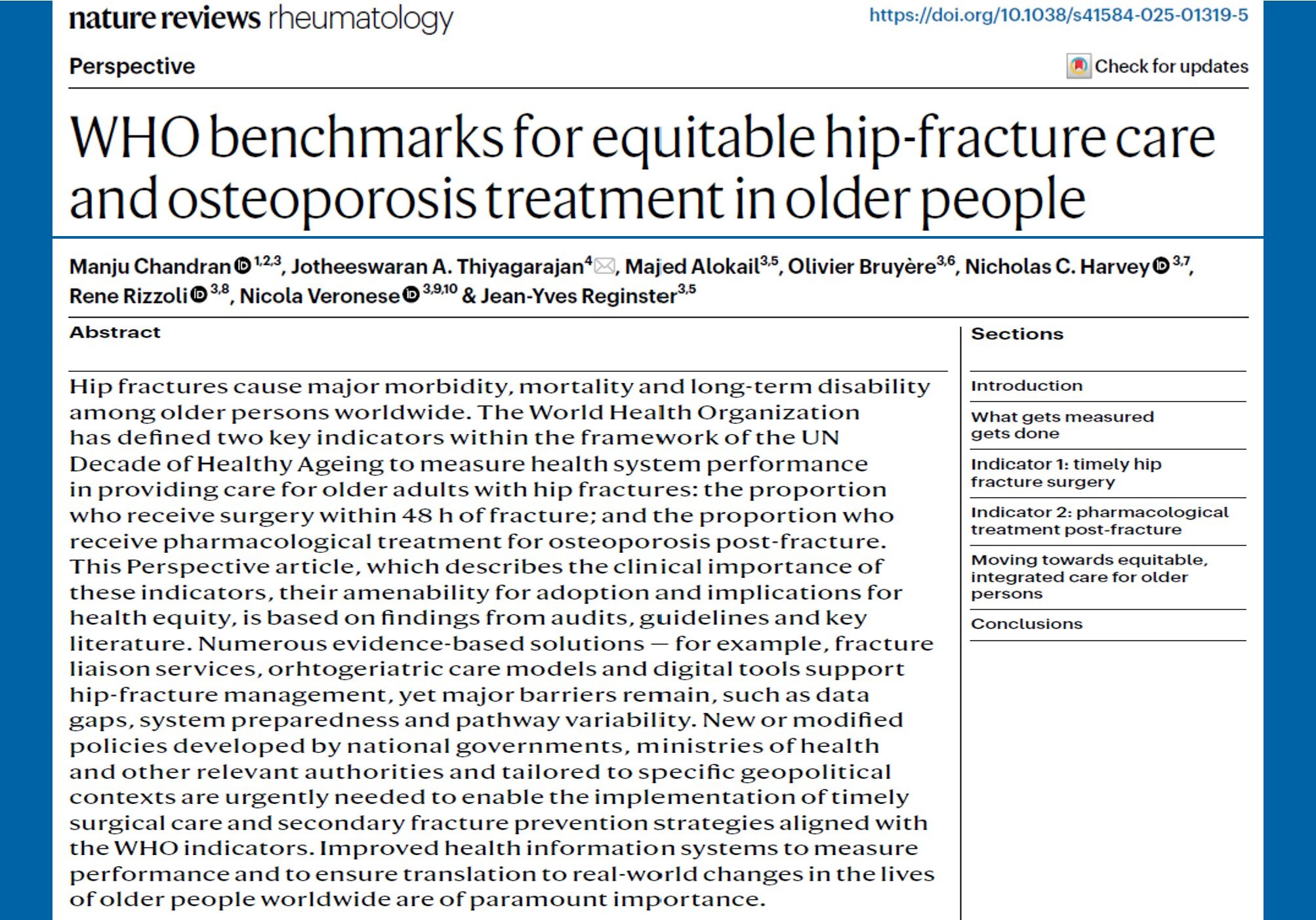
On 6 November 2025, Nature Reviews Rheumatology published an important Perspective titled “WHO benchmarks for equitable hip-fracture care and osteoporosis treatment in older people.” Led by Prof Manju Chandran, Chairperson of the Asia Pacific Consortium on Osteoporosis (APCO), this paper marks a major milestone for the global bone health community.

As populations age at unprecedented speeds, hip fractures have become one of the most serious and costly consequences of osteoporosis. Yet despite decades of research and the availability of proven treatments, the quality of hip-fracture care remains inconsistent across and even within countries. The new WHO benchmarks spotlight a simple truth: older people everywhere deserve timely, evidence based, and equitable care, and we now have a clear framework to evaluate whether systems are delivering it.


Why Hip-Fracture Care Needs Benchmarking
Hip fractures are life altering injuries. For older people, they often lead to permanent disability, loss of independence, and, in many cases, premature mortality. What’s most striking is that these outcomes are not inevitable; they are strongly influenced by the quality of care delivered in the first hours, days, and months after the fracture.

Yet across the world, large gaps persist. Many patients wait far too long for surgery. Even more never receive osteoporosis treatment after the fracture, leaving them at high risk of another, potentially more devastating, break. Without consistent data or clear standards, health systems struggle to evaluate their performance or make meaningful improvements. The WHO benchmarks introduced in this paper aim to change that.


The Two WHO Benchmarks: Simple, Actionable, and Powerful
The Perspective highlights two core indicators that the WHO recommends for assessing health system performance in older persons who suffer hip fractures:

  1. Timely surgery
    Prompt surgery is one of the strongest predictors of survival and recovery after a hip fracture. Evidence shows that delays increase the risks of complications such as infection, blood clots, and prolonged immobility, all of which worsen long-term outcomes. By tracking the proportion of patients who receive surgery within 48 hours, health systems can identify bottlenecks, address resource constraints, and ensure that emergency, orthopaedic, and geriatric services are aligned.
  2. Osteoporosis treatment after a hip fracture
    A hip fracture is rarely an isolated event. It is often a warning sign of underlying osteoporosis, and without treatment, the chances of suffering another fracture, often within months, are extremely high. Measuring the proportion of hip-fracture patients who are started on appropriate osteoporosis medication helps ensure that fracture prevention does not stop at the operating room. It also encourages the adoption of proven models such as Fracture Liaison Services (FLS), which are specifically designed to close this critical treatment gap.


Why These Benchmarks Are so Important

  • They shift focus from “can care be provided?” to “is care actually being delivered?”
    Many countries have clinical guidelines for fracture care and osteoporosis treatment, but implementation is highly variable. These benchmarks move the conversation from theoretical recommendations to measurable, real-world performance.
  • They promote fairness and equity
    Older people in rural areas, under-resourced hospitals, or low-income settings are often at the greatest risk of delayed surgery and missed osteoporosis treatment. Benchmarks expose disparities and provide a basis for targeted system-level action.
  • They are globally applicable
    Unlike complex quality indicators that require advanced health IT systems, these two benchmarks are straightforward, feasible, and meaningful across diverse health system contexts.
  •  They strengthen the link between acute care and long-term bone health
    The paper reinforces an essential message: a hip fracture is both an emergency and a chronic disease management issue. Good care must include not only skilled surgery but also long-term strategies to prevent future fractures.


Barriers Identified and Why This Paper Calls Us to Act
The authors highlight several barriers that still prevent consistent delivery of high quality hip-fracture care:

  • Data gaps: Many countries lack reliable systems to track fracture incidence, surgical timing, or osteoporosis treatment rates.
  • Health system unpreparedness: Variability in resources, training, and coordination leads to inconsistent care delivery.
  • Limited adoption of FLS and orthogeriatric models: Despite their strong evidence base, these services are not yet widely implemented.
  • Equity issues: Socioeconomic, geographic, and demographic factors strongly influence access to timely care.

By presenting benchmarks and outlining the steps needed to adopt them, the paper calls on governments, policymakers, and health leaders to make hip-fracture care a priority not just clinically, but structurally.


Why This Matters for the Bone Health Community in Asia-Pacific
The Asia-Pacific region is experiencing one of the fastest rates of population ageing in the world. As life expectancy rises, hip fractures are increasing rapidly across countries such as Singapore, Japan, China, Australia, India, and many others in the region. This means the burden of osteoporosis and its consequences is growing much faster here than in most other parts of the world.

Despite this rising need, hip-fracture care across Asia-Pacific remains highly variable. Some countries have well established orthogeriatric pathways and Fracture Liaison Services (FLS), whereas others still face significant challenges such as delays in surgery, under-diagnosis of osteoporosis, limited access to treatments, and gaps in post-fracture follow-up. These inequalities mean that older adults with similar fractures often receive very different levels of care depending on where they live.

This is why the WHO benchmarks are so crucial for the region.

  • They provide a common, clear standard that every health system, regardless of size, resources, or maturity, can aim for: timely surgery within 48 hours and appropriate osteoporosis treatment after the fracture.
  • They make performance visible, enabling countries to measure how well they are caring for their older citizens and where improvements are needed.
  • They align directly with APCO’s mission to raise the standard of osteoporosis care across Asia-Pacific by promoting consistent, evidence-based practices.
  • They support advocacy efforts by giving clinicians, researchers, and policymakers a straightforward set of indicators to present to health ministries, hospital leaders, and funding agencies.
  • They help reduce inequities by ensuring that high-quality hip-fracture care is not limited to a few advanced centers but becomes a regional expectation.

For APCO and the wider bone health community, these benchmarks offer a powerful tool to accelerate system-level reforms, strengthen regional collaboration, and ensure that older adults in Asia-Pacific receive the care they need urgently, consistently, and equitably.


Read the Full Article
WHO benchmarks for equitable hip-fracture care and osteoporosis treatment in older people
Published in Nature Reviews Rheumatology, 6 November 2025
https://www.nature.com/articles/s41584-025-01319-5
 

News

AdobeStock_319401244-2

Osteopenia – To treat or not to treat. That is the question

AI

Fixing a Fractured Future – Can Artificial Intelligence help?

Osteoporosis

Not just garden-variety osteoporosis: secondary osteoporosis and its management

DXA Scanning

DXA scanning facility quality standards – Are we falling woefully short?

Osteoporosis nurse

Florence Nightingale in the Asia Pacific – the osteoporosis nurse and her role in battling the silent disease

Low Calcium Intake

Reference 1: This review examined calcium intake among adults around the world and found that many populations do not consume enough calcium to support good bone health. The authors highlight that low calcium intake is particularly common in many Asian countries, where average intakes are often well below recommended levels. Because calcium is essential for building and maintaining strong bones, inadequate intake may increase the risk of osteoporosis and fractures. The study emphasises the importance of promoting calcium rich foods and other practical ways to help people meet their daily calcium needs.

Citation: Balk EM, Adam GP, Langberg VN, et al. “Global dietary calcium intake among adults: a systematic review.” Osteoporos Int. 2017 Dec;28(12):3315-3324. doi: 10.1007/s00198-017-4230-x. Epub 2017 Oct 12. Erratum in: Osteoporos Int. 2018 May;29(5):1223. doi: 10.1007/s00198-018-4447-3. PMID: 29026938; PMCID: PMC5684325.


Reference 2: This review explores the important role of calcium in maintaining healthy bones throughout life. The authors explain that adequate calcium intake helps build and maintain bone strength, while long term low intake may contribute to bone loss and increase the risk of fractures. The paper also discusses the importance of obtaining calcium from a balanced diet, with supplements considered when dietary intake is insufficient. Overall, the review reinforces that meeting daily calcium needs is an important part of supporting lifelong bone health.

Citation: Cormick G, Belizan JM. “Calcium Intake and Health.” Nutrients. 2019 Jul 15;11(7):1606. doi: 10.3390/nu11071606. PMID: 31311164; PMCID: PMC6683260.


Reference 3: This review explores how common calcium deficiency is around the world and the impact it can have on health. The authors explain that many people do not consume enough calcium, particularly in low and middle income countries, increasing the risk of poor bone health and fractures. The paper highlights the importance of consuming enough calcium throughout life to help build and maintain strong bones. It also emphasises the need for practical strategies, such as improving access to calcium rich foods, fortified foods, and nutrition education, to help people meet their daily calcium needs.

Citation: Shlisky J, Mandlik R, Askari S, et al. “Calcium deficiency worldwide: prevalence of inadequate intakes and associated health outcomes.” Ann N Y Acad Sci. 2022 Jun;1512(1):10-28. doi: 10.1111/nyas.14758. Epub 2022 Mar 5. PMID: 35247225; PMCID: PMC9311836.

High Sodium Intake

Reference 1: This review explored whether eating too much salt affects bone health in postmenopausal women. The authors found that while high salt intake may increase calcium loss from the body, there is currently not enough high quality evidence to clearly determine its long term effects on bone mineral density or fracture risk. The paper highlights the need for more research to better understand this relationship. In the meantime, following general recommendations to limit excessive salt intake remains an important part of maintaining overall health.

Citation: Imash D, Gusmanov A, Chan MY. “High salt intake and bone health in postmenopausal women: exposing the lack of studies – a systematic review and meta-analysis.” Front Endocrinol (Lausanne). 2025 Nov 19;16:1694539. doi: 10.3389/fendo.2025.1694539. PMID: 41347127; PMCID: PMC12672310.


Reference 2: This study explored whether salt intake was linked to bone health in postmenopausal women in southern India. The authors found that women who consumed more salt were more likely to have weaker bones, poorer bone structure, osteoporosis, and vertebral fractures. These findings suggest that excessive salt intake may be associated with poorer bone health in this population. The study adds to growing evidence that a balanced diet, including limiting excess salt, may help support healthy bones.

Citation: John R, Cherian KE, Kapoor N, et al. “Excess dietary salt is associated with an altered bone strain index, degraded bone microarchitecture, vertebral fractures, and increased prevalence of osteoporosis in postmenopausal women – A study from a teaching hospital in southern India.” Aging Med (Milton). 2024 Oct 10;7(5):606-613. doi: 10.1002/agm2.12360. PMID: 39507226; PMCID: PMC11535168.

Lower Protein Intake Among Older Adults

Reference 1: This review explored how protein intake and regular exercise can help slow the progression of age-related muscle loss in older adults living in the community. The authors found that combining adequate protein with strength or resistance exercise was more effective than either approach alone in helping to maintain muscle strength and physical function. The paper highlights that preserving muscle health is important for reducing the risk of falls, fractures, and loss of independence. It also reinforces the value of healthy lifestyle habits in supporting active and healthy ageing.

Citation: Li L, He Y, Jin N, Li H, Liu X. “Effects of protein supplementation and exercise on delaying sarcopenia progression in Asian community-dwelling older adults.” Food Chem X. 2022 Jan 20;13:100210. doi: 10.1016/j.fochx.2022.100210. PMID: 35128383; PMCID: PMC8808080.


Reference 2: This consensus paper encourages a broader focus on maintaining muscle health throughout life rather than only identifying or treating sarcopenia after it develops. The authors explain that healthy muscles are essential for mobility, balance, independence, and overall wellbeing, especially as people age. The paper highlights the importance of regular physical activity, good nutrition, and early action to help preserve muscle strength and function. It also encourages healthcare professionals and the public to view muscle health as an important part of healthy ageing alongside bone health.

Citation: Chen LK, Hsiao FY, Akishita M, et al. “A focus shift from sarcopenia to muscle health in the Asian Working Group for Sarcopenia 2025 Consensus Update.” Nat Aging. 2025 Nov;5(11):2164-2175. doi: 10.1038/s43587-025-01004-y. Epub 2025 Nov 4. PMID: 41188603.

High Prevalence of Lactose Intolerance

Reference 1: This review explores how lactose intolerance may affect bone health. The authors explain that people who avoid dairy because of lactose intolerance may miss out on important nutrients, particularly calcium, if these nutrients are not replaced from other foods. The paper highlights that getting enough calcium is important for maintaining strong bones and reducing the risk of fractures. It also emphasises that there are many ways to meet calcium needs, including lactose free dairy products and other calcium rich foods.

Citation: Hodges JK, Cao S, Cladis DP, Weaver CM. “Lactose Intolerance and Bone Health: The Challenge of Ensuring Adequate Calcium Intake.” Nutrients. 2019 Mar 28;11(4):718. doi: 10.3390/nu11040718. PMID: 30925689; PMCID: PMC6521087.


Reference 2: This review explores whether drinking milk can help support bone health in Asian populations, particularly those at higher risk of osteoporosis. The authors highlight that many people in Asia consume less milk than recommended, which may contribute to lower calcium intake and poorer bone health. The paper explains that milk provides important nutrients for strong bones and discusses practical options for people who cannot tolerate regular milk, such as lactose free milk and yoghurt. Overall, the review suggests that finding suitable ways to include dairy or alternative calcium rich foods in the diet may help support lifelong bone health.

Citation: Jiao H, Xu Y, Zhang Y, et al. “Is it advisable for Asians to drink milk, especially those at risk of osteoporosis?” Front Nutr. 2025 Jun 25;12:1586623. doi: 10.3389/fnut.2025.1586623. PMID: 40635901; PMCID: PMC12239142.


Reference 3: This review explores ways to protect bone health in populations where calcium and vitamin D intake is often too low. The authors explain that getting enough of these nutrients is essential for building and maintaining strong bones, yet deficiencies remain common in many parts of the world. The paper highlights that healthy eating, safe sun exposure, regular physical activity, and, where needed, fortified foods or supplements can all help support bone health. It also emphasises the importance of public health efforts to improve awareness and make nutritious foods more accessible, particularly for people at greater risk of osteoporosis.

Citation: Yeum KJ, Ju S, Choe U. “Strategies for preventing bone loss in populations with inadequate calcium and vitamin D intake.” Nutr Res Pract. 2025 Apr;19(2):155-169. doi: 10.4162/nrp.2025.19.2.155. Epub 2025 Mar 13. PMID: 40226767; PMCID: PMC11982687.

Vitamin D Deficiency Despite Sunshine

Reference 1: This review examined how common vitamin D deficiency is around the world and found that it remains a widespread public health concern. The authors explain that many people do not get enough vitamin D because of factors such as limited sun exposure, diet, and lifestyle. As vitamin D plays an important role in maintaining strong bones and muscles, low levels may increase the risk of poor bone health. The study highlights the importance of improving awareness and ensuring people have adequate vitamin D through safe sun exposure, diet, fortified foods, or supplements when needed.

Citation: Cui A, Zhang T, Xiao P, Fan Z, Wang H, Zhuang Y. “Global and regional prevalence of vitamin D deficiency in population-based studies from 2000 to 2022: A pooled analysis of 7.9 million participants.” Front Nutr. 2023 Mar 17;10:1070808. doi: 10.3389/fnut.2023.1070808. PMID: 37006940; PMCID: PMC10064807.


Reference 2: This review examined vitamin D levels among adults living in South Asia and found that vitamin D deficiency is very common across the region. The authors explain that factors such as limited sun exposure, lifestyle, skin pigmentation, and diet may all contribute to low vitamin D levels. Because vitamin D is essential for maintaining healthy bones and muscles, addressing this deficiency is an important part of supporting lifelong bone health. The study highlights the need for greater awareness and practical strategies to help people achieve adequate vitamin D levels.

Citation: Siddiqee MH, Bhattacharjee B, Siddiqi UR, MeshbahurRahman M. “High prevalence of vitamin D deficiency among the South Asian adults: a systematic review and meta-analysis.” BMC Public Health. 2021 Oct 9;21(1):1823. doi: 10.1186/s12889-021-11888-1. PMID: 34627207; PMCID: PMC8501935.

Vegetarian and Plant-Based Diets

Reference 1: This review explores how vegetarian diets may affect bone health. The authors explain that while well planned vegetarian diets can provide many health benefits, they may also be lower in important nutrients such as calcium, vitamin D, protein, and vitamin B12 if not carefully balanced. The paper highlights that these nutrients play an important role in maintaining strong bones and reducing the risk of fractures. It also emphasises that people following vegetarian diets can support their bone health by choosing a varied, nutrient-rich diet and including fortified foods or supplements when needed.

Citation: Falchetti A, Cavati G, Valenti R, et al. “The effects of vegetarian diets on bone health: A literature review.” Front Endocrinol (Lausanne). 2022 Aug 5;13:899375. doi: 10.3389/fendo.2022.899375. PMID: 35992115; PMCID: PMC9388819.


Reference 2: This review examines how vegetarian diets may influence bone mineral density, a measure of bone strength. The authors explain that people following vegetarian diets may have lower bone mineral density if they do not consume enough nutrients that are important for healthy bones, such as calcium, vitamin D, and protein. However, the paper also highlights that a well planned vegetarian diet can support good bone health when these nutritional needs are met. The review emphasises the importance of choosing a balanced diet to help maintain strong bones throughout life.

Citation: Chuang TL, Lin CH, Wang YF. “Effects of vegetarian diet on bone mineral density.” Tzu Chi Med J. 2020 Sep 16;33(2):128-134. doi: 10.4103/tcmj.tcmj_84_20. PMID: 33912409; PMCID: PMC8059457.


Reference 3: This review examined how vegan and vegetarian diets may affect bone mineral density and fracture risk. The authors found that people following plant based diets, particularly vegan diets, may have lower bone mineral density and a higher risk of fractures if they do not get enough nutrients that support bone health. The paper highlights the importance of consuming adequate calcium, vitamin D, protein, and other key nutrients when following a plant based diet. It also emphasises that well planned vegetarian and vegan diets can support healthy bones when nutritional needs are carefully met.

Citation: Iguacel I, Miguel-Berges ML, Gomez-Bruton A, Moreno LA, Julian C. “Veganism, vegetarianism, bone mineral density, and fracture risk: a systematic review and meta-analysis.” Nutr Rev. 2019 Jan 1;77(1):1-18. doi: 10.1093/nutrit/nuy045. PMID: 30376075.

I Think I Might Be at Risk of Osteoporosis

Why should I ask?

Osteoporosis is often called the “silent disease” because there are usually no symptoms until a fracture occurs. If you have risk factors, it is important to discuss your bone health before a fracture happens. Some common risk factors include but not limited to: Family history, Smoking, Alcohol, Low Body Weight, Age and Previous Falls.

Questions to ask your Doctor

1Am I at risk of osteoporosis?
2Should I have a bone health assessment?
3Should I have a DXA scan?
4What are my personal risk factors for osteoporosis and fractures?
5Are any of my medications affecting my bone health?
6What lifestyle changes can help protect my bones?

I am experiencing Height Loss, Stooped Posture, or Bone Pain

Why should I ask?

Losing height, developing a stooped posture or experiencing persistent back pain may not simply be part of ageing. These symptoms can sometimes be caused by vertebral fractures that happen without a major injury.

Questions to ask your Doctor

1Could my symptoms be caused by osteoporosis?
2Should I have spinal imaging or a VFA?
3Could I have had a spinal fracture without realising it?
4What treatments are available if I have vertebral fractures?
5How can I reduce my risk of future fractures?

I have Risk Factors but my DXA Scan was Normal

Why should I ask?

A normal bone density result does not always mean your bones are healthy. Some people may still be at increased fracture risk because of other risk factors or underlying conditions that affect bone quality.

Questions to ask your Doctor

1Does a normal DXA scan mean I cannot have osteoporosis?
2Why am I still at risk of fractures?
3Should my fracture risk be assessed using other tools?
4Are there additional tests I should have?
5How often should my bone health be reviewed?

I am worried about being on an Osteoporosis Medication

Why should I ask?

Many people are concerned about possible side effects of osteoporosis medicines. Understanding both the benefits and risks can help you make an informed decision with your doctor.

Questions to ask your Doctor

1Why are you recommending this medication?
2What are the common side effects?
3How common are the serious side effects?
4What happens if I decide not to take treatment?
5Are there other treatment options that may be suitable for me?

I am going through Menopause

Why should I ask?

Bone loss accelerates during and after menopause because of declining oestrogen levels. Acting early can help maintain bone strength and reduce future fracture risk.

Questions to ask your Doctor

1Does menopause increase my risk of osteoporosis?
2Should I have a DXA scan?
3Am I getting enough calcium and vitamin D?
4Would hormone therapy or another treatment benefit me?
5What lifestyle changes can help protect my bones?

I Have Another Medical Condition That May Affect My Bones

Why should I ask?

Some medical conditions can weaken bones, affect bone quality or interfere with the body’s ability to absorb important nutrients. Others may increase your risk of falls and thus fractures. These include diabetes, rheumatoid arthritis, thyroid disease, kidney disease, celiac disease among others.

Questions to ask your Doctor

1Does my medical condition increase my risk of osteoporosis or fractures?
2Should I have a DXA scan or other bone health tests?
3Are there treatments that can help protect my bones?
4Do I need to see a bone specialist?
5How often should my bone health be monitored?

I take Long-Term Medicines

Why should I ask?

Some medicines can reduce bone strength or increase fracture risk, particularly if they are taken over a long period. Your doctor can help determine whether you need additional monitoring or treatment.

Questions to ask your Doctor

1Could this medication affect my bones?
2Should I have a DXA scan?
3Do I need calcium or vitamin D supplements?
4Should I take medication to help protect my bones?
5How often should my bone health be reviewed while taking this medication?

I am Falling More Often and am Worried about my Balance

Why should I ask?

Most fragility fractures occur after a fall. Identifying the causes of falls and improving balance and strength can significantly reduce your fracture risk.

Questions to ask your Doctor

1Why might I be falling more often?
2Could my medications be contributing?
3Should my vision or hearing be checked?
4Would physiotherapy or balance training help?
5Can I be referred to a falls prevention programme?

I am an Older Man

Why should I ask?

Although osteoporosis is often thought of as a women’s disease, men can also develop osteoporosis and experience serious fractures. Unfortunately, osteoporosis in men is frequently under-recognised and underdiagnosed.

Questions to ask your Doctor

1Can men develop osteoporosis?
2Should I have a bone density test?
3What are my personal risk factors?
4Do I need treatment to reduce my fracture risk?
5Are there lifestyle changes I should make?

My Blood Tests show Low Vitamin D and/or Low Calcium

Why should I ask?

Vitamin D and calcium play essential roles in maintaining healthy bones. Low levels may contribute to bone loss and increase the risk of fractures if left untreated.

Questions to ask your Doctor

1What may have caused my low vitamin D and/or calcium levels?
2Do I need supplements?
3How much calcium and vitamin D should I be taking?
4Should my levels be checked again?
5Are there other tests needed to identify the underlying cause of my my low vitamin D and/or calcium levels?